What to Do With Farmers Market Vegetables You've Never Cooked Before
What to Do With Farmers Market Vegetables You've Never Cooked Before
You went to the market. Something caught your eye — a purple vegetable you couldn't identify, an herb that smelled extraordinary, a root you've never seen before. You bought it.
Now it's sitting on your counter and you have no idea what to do with it.
This happens to almost everyone who shops seasonally at farmers markets, and it's one of the best things about it. Getting something unfamiliar forces you to learn — and what you learn usually makes you a more confident, more versatile cook.
Here's a practical guide for the most common unfamiliar vegetables you'll encounter at Idaho farmers markets — and the simplest honest way to cook each one.
The Universal Starting Point
Before getting into specifics, here's the approach that works for almost any vegetable you don't know what to do with:
Roast it.
Cut it into pieces of roughly the same size. Toss with olive oil, salt, and pepper. Spread on a sheet pan without crowding. Roast at 400–425°F until tender and slightly caramelized at the edges — anywhere from 15 to 45 minutes depending on density.
Roasting works for almost everything: root vegetables, brassicas, alliums, summer squash, winter squash, green beans, asparagus, beets. The heat caramelizes natural sugars and concentrates flavor in a way that makes even unfamiliar vegetables approachable.
If you don't know what to do with it — roast it. Then decide what it needs from there.
The Vegetables You're Most Likely to Encounter
Kohlrabi
Looks like an alien spacecraft. Tastes like a mild, sweet broccoli stem crossed with an apple. The entire thing is edible — bulb and leaves.
To eat it raw: peel the outer skin, slice thin, and eat with hummus or in a slaw. Add a squeeze of lemon and salt. Excellent texture — crunchy and refreshing.
To cook it: cut into wedges and roast until tender and golden. Or cut into matchsticks and sauté with butter and garlic until slightly caramelized.
The leaves cook like any braising green — wilted in olive oil with garlic.
Celeriac (Celery Root)
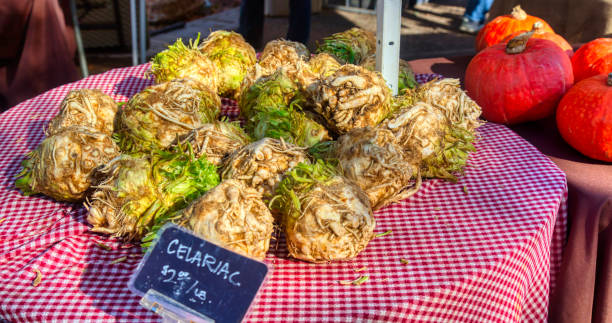
An ugly brown sphere that looks like it was unearthed from something primordial. Tastes like celery, but milder and nuttier, with more body.
To use it raw: peel deeply (the exterior is rough and inedible), grate or julienne, and toss with a mustardy vinaigrette. This is céleri rémoulade — a French bistro classic that celeriac was born for.
To cook it: roast in cubes until golden and tender. Or peel, cube, and simmer in salted water until very soft, then mash with butter and cream. Celeriac mash is one of the best things you'll ever put on a plate.
Hakurei Turnips
Small, white, golf ball-sized. Not at all like the large purple turnips most people associate with the word "turnip." These are sweet, mild, and delicate.
To eat raw: slice thin and eat like a radish — with butter and salt, in a salad, as a crudité.
To cook: halve and sauté in butter over medium-high heat until golden on the cut side. Add a splash of water, cover, and let steam until tender. Season with salt and a squeeze of lemon. They're done in eight minutes and taste like the best version of a vegetable you've never tried before.
Purslane
A low-growing succulent with thick, juicy leaves. You've probably seen it growing as a weed. At the farmers market, it's a genuine crop — and one of the most nutrient-dense plants you can eat.
It has a mild, slightly lemony, slightly mucilaginous quality (which is a fancy word for slightly slippery — think okra but much less so).
To eat raw: toss with olive oil, lemon juice, salt, and whatever else is in your salad. The texture is refreshing and the flavor is subtle.
To cook: wilt briefly in olive oil or butter. It collapses significantly and is excellent with eggs — fold wilted purslane into scrambled eggs or an omelet.
Garlic Scapes
The curly green shoots that grow from hardneck garlic plants before the garlic bulb matures. They taste like mild garlic — more delicate, with a pleasant fresh quality.
To use: treat them like a vegetable version of garlic. Chop and use anywhere you'd use garlic — in stir-fries, pasta, omelets, roasted with vegetables. They're also excellent grilled whole until slightly charred, finished with olive oil and salt.
Garlic scape pesto — scapes, olive oil, lemon, parmesan, pine nuts or walnuts, blended — is one of the best pestos you'll ever make.
Romanesco
The mathematically perfect brassica that looks like it was designed by someone who loved spirals a little too much. Bright green, fractal, spectacular. Tastes like a mild, slightly nutty version of cauliflower.
To cook: cut into florets and roast at high heat until the edges are deeply caramelized. Or shave raw into a salad with lemon and parmesan. Or steam briefly and serve with good olive oil and flaky salt.
Don't overcook it — it should have some bite and keep its striking color.
Watermelon Radish
Green outside, magenta inside. The interior color is one of the more dramatic things in a farmers market. Tastes mild and slightly peppery — less sharp than regular radishes.
To use raw: slice thin and the color is the whole point. Add to salads, grain bowls, or any dish that benefits from something visually striking.
To cook: roasting mellows the sharpness and sweetens them. The color fades somewhat with heat but the flavor deepens.
The Best Question to Ask
When you buy something unfamiliar at the farmers market, ask the farmer one question: "How do you eat it?"
Not "what can I make with it?" — the farmer knows what they do with it, which is usually the simplest and best answer. The person who grows it has eaten it a hundred times and will give you the answer that actually works, not the answer that requires a recipe and twelve ingredients.
That one question has introduced me to preparations I never would have found on my own. It's also the most reliable way to get better at eating seasonally — letting the people who grow the food teach you what to do with it.
Happy Idaho connects Idaho consumers with the local farmers, makers, and food producers who are growing something worth learning about. Find your nearest market at happyidaho.com/find-local
