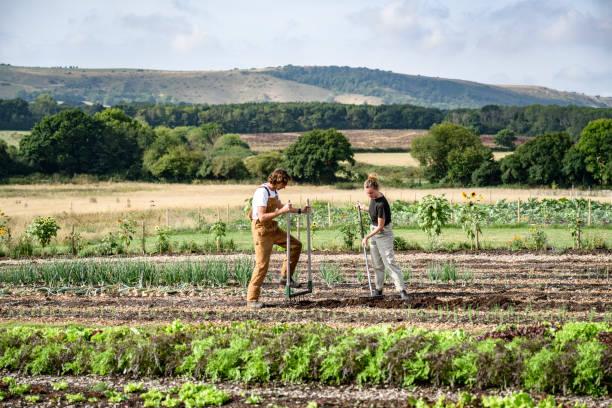
What Is Regenerative Farming — And Why Does It Matter for Your Food?
What Is Regenerative Farming — And Why Does It Matter for Your Food?
You've probably started seeing the word "regenerative" on farm stands, market signs, and local food packaging. It's showing up everywhere right now — and unlike a lot of food marketing terms, it actually means something specific.
This is the plain-language explanation of what regenerative farming is, why it's different from organic, and why it matters for the food you buy and the land it came from.
The Problem It's Responding To
To understand regenerative farming, it helps to understand what it's responding to.
Conventional industrial agriculture — the system that produces most of the food sold in grocery stores — optimizes for yield and efficiency. More output per acre, more seasons per year, lower cost per unit. These are legitimate goals. They're also achieved through methods that, over time, have significant costs.
Tilling soil repeatedly destroys the structure that makes it healthy and productive. Synthetic fertilizers replace natural soil biology with chemical inputs that the plant can use but that don't support the broader ecosystem underground. Monocultures — growing a single crop across vast acreage — eliminate biodiversity and make crops vulnerable to disease and pests, which leads to more pesticide use. Over decades, this approach degrades the very resource it depends on: healthy, living soil.
The USDA estimates that American topsoil — the layer of soil where crops actually grow — is being lost at a rate roughly ten times faster than it's being replenished. Some projections suggest that at current rates, much of the world's topsoil could be depleted within a few generations.
Regenerative farming is a direct response to this. Not a rejection of productivity, but a different theory of how to achieve it without destroying the underlying system.
What Regenerative Farming Actually Does
Regenerative agriculture is built around one core principle: farming should improve the land, not deplete it.
In practice, this means farming practices that build soil health over time rather than mining it. The specific methods vary by farm and context, but the most common approaches include:
No-till or minimal tillage. Leaving soil structure intact rather than disrupting it with plowing. Healthy soil has a complex underground ecosystem — fungal networks, bacteria, earthworms, billions of microorganisms — that tillage destroys. Leaving it undisturbed allows it to function.
Cover cropping. Planting crops specifically to cover and protect soil between growing seasons. Cover crops prevent erosion, fix nitrogen naturally, and feed the soil biology that makes future crops more productive.
Rotational grazing. Moving livestock across pasture in a managed pattern that mimics how grazing animals historically moved across landscapes. Done correctly, this builds soil organic matter, increases water retention, and improves pasture health over time.
Composting and natural fertility. Building soil nutrients through organic matter rather than synthetic fertilizers. This feeds the soil ecosystem rather than bypassing it.
Biodiversity. Growing multiple crops, integrating livestock with crop production, maintaining hedgerows and wild areas — practices that support a variety of species and reduce vulnerability to disease and pests.
How Is This Different from Organic?
This is the most common question, and it's a fair one.
Organic certification means a farm isn't using synthetic pesticides or fertilizers. That's a meaningful standard. But organic certification doesn't require building soil health. An organic farm can till repeatedly, grow monocultures, and deplete soil — and still be certified organic as long as it avoids the specific prohibited inputs.
Regenerative farming focuses on outcomes — specifically, whether the land is becoming healthier over time. Some regenerative farms are also certified organic. Many aren't, because the organic certification process is expensive and time-consuming, particularly for small farms. But the philosophical goal of regenerative agriculture goes further than what organic certification requires.
Think of it this way: organic tells you what a farm doesn't use. Regenerative tells you what a farm is actively trying to build.
There's no official government certification for "regenerative" yet, which means the term isn't legally defined the way "organic" is. That's worth knowing. A farm calling itself regenerative should be able to explain specifically what practices they use and how those practices improve soil health. If they can — and if the answer is specific and credible — that's a good sign.
Does It Affect the Food Itself?
This is the question most people actually want answered: is regeneratively grown food better to eat?
The honest answer is that the research is still developing, but the early evidence is encouraging. Produce grown in healthy, biologically active soil appears to contain higher levels of certain micronutrients than produce grown in depleted soil with synthetic inputs. The mechanism makes sense — plants access nutrients through their relationship with soil biology, and when that biology is healthy and diverse, the plant's nutrient uptake improves.
The more certain answer is about the system rather than the individual food item. A farm that is building soil health every year is a farm that can continue producing food at the same quality for generations. A farm that is depleting its soil every year is borrowing against a future it won't be able to repay. The food from both farms might look similar on a plate today. It won't look similar in thirty years.
Why It Matters When You Shop at a Market
When you buy produce, meat, eggs, or honey from a local farmer at a farmers market, you have an opportunity that doesn't exist at a grocery store: you can ask.
Ask the farmer what their relationship is with their soil. Ask if they till. Ask what they do to build fertility. Ask about their animals' relationship to the land. Most farmers who are doing this work thoughtfully will light up at these questions — because it's rare for a customer to ask them, and because the answers reflect real choices they've made.
You don't need to know every regenerative practice or be able to evaluate a soil health assessment. You just need to notice whether the farmer can speak specifically and credibly about how their land is doing.
A farmer who says "our soil gets healthier every year and here's what we do to make that happen" is telling you something meaningful. It affects what they grow, how they grow it, and how sustainable their operation is over time.
That's worth knowing — and worth supporting.
Happy Idaho connects Idaho consumers with the local makers, farmers, and food producers doing real work on real land. Browse local vendors and find your nearest market at happyidaho.com/find-local
